MECA

Model Engine Collectors Association

What is the Model Engine Collectors Association (MECA)?


MECA Needs You
 

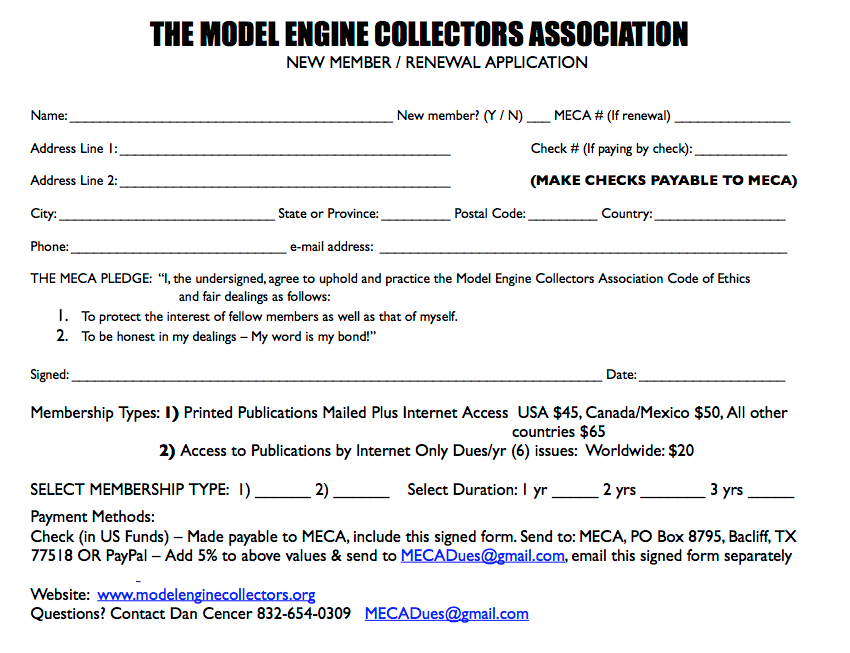
For information on becoming a member of MECA, go to the Join Tab for a Membership Application and instructions.

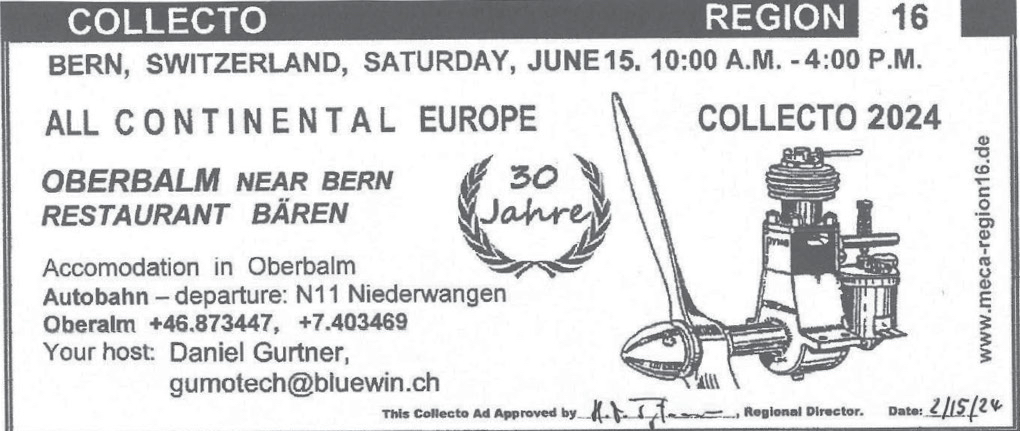
To find out about MECA swap meets called "Collectos" that take place world wide throughout the year, where engines and models may be bought, sold, or traded in person, go to the Collectos Tab to view the latest scheduled Collectos.

A Brief Background


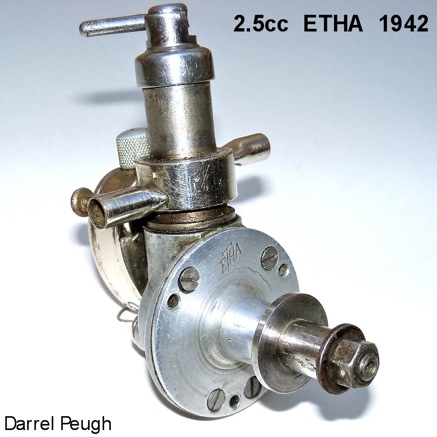
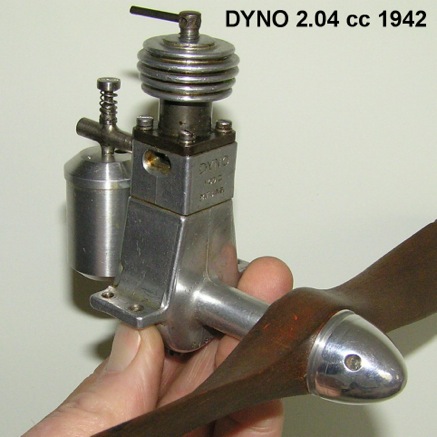
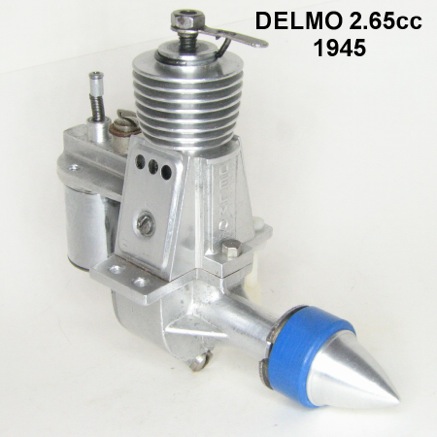
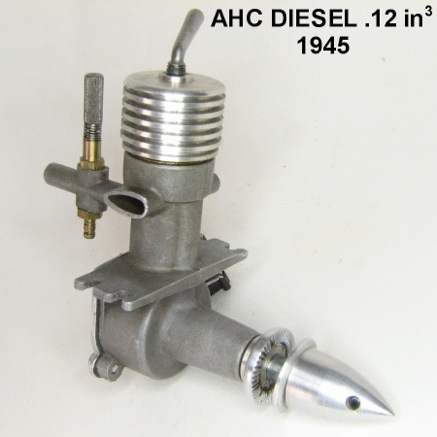
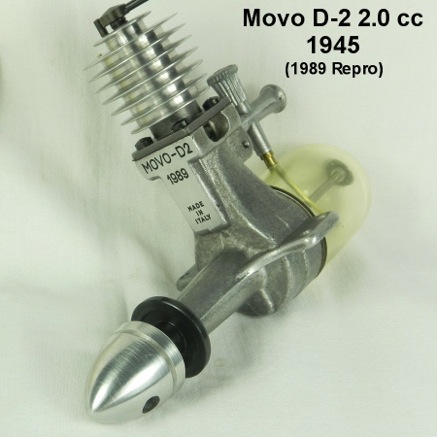
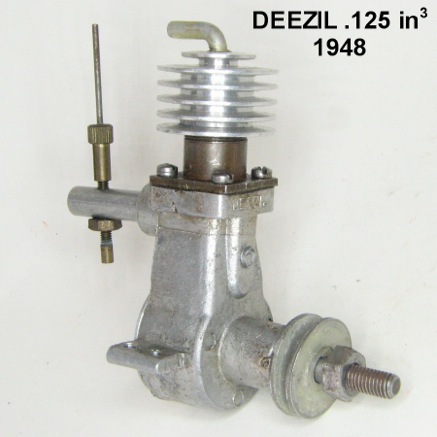
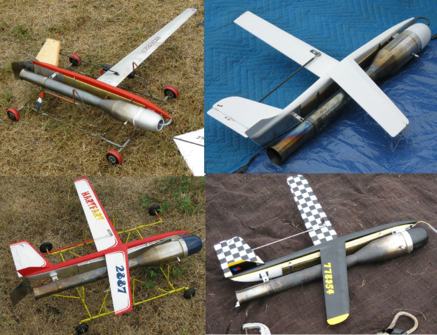
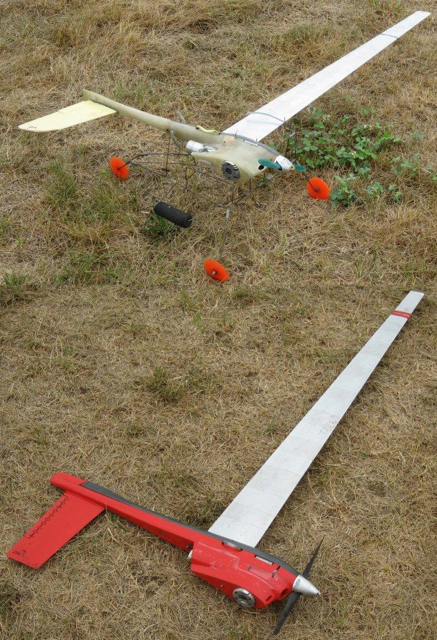
The first half of the 20th century saw incredible progress in the internal combustion engine and all forms of transportation technology.  Children growing up during those years wanted to emulate these advances in technology in their extra-curricular activities, with an eye toward joining the teams making daily headlines.  The earliest model airplanes were either gliders, or powered by rubber strands or compressed air.  When light, powerful internal combustion model airplane engines burst upon the scene, modeling was changed forever.  These small engines were used to power model cars and boats, as well, replacing the larger engines that had been available.

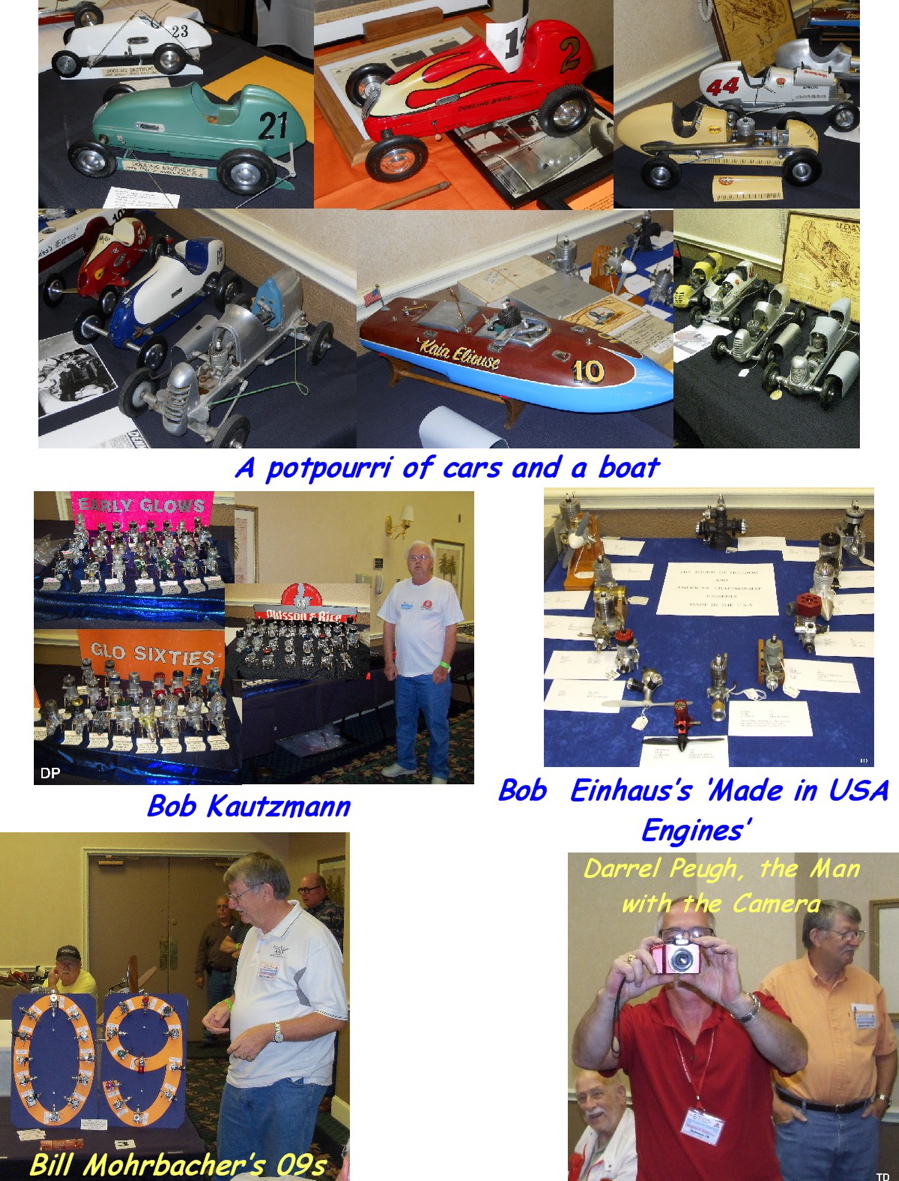
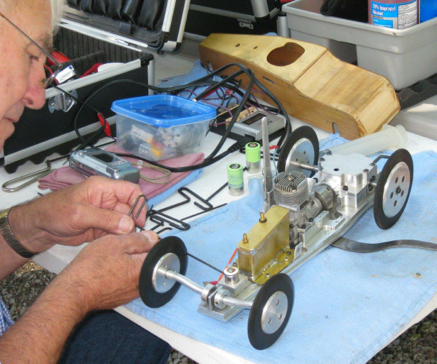
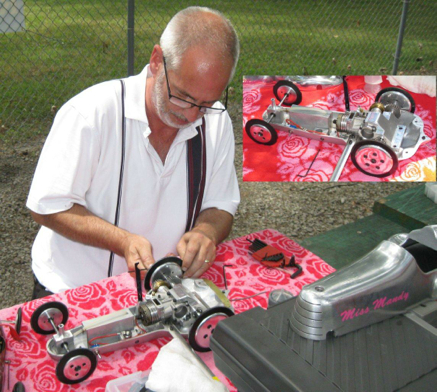
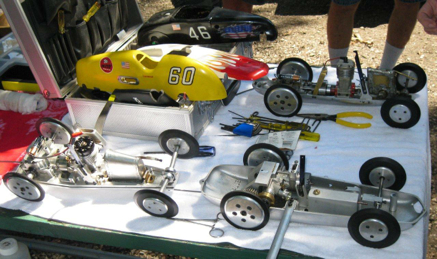
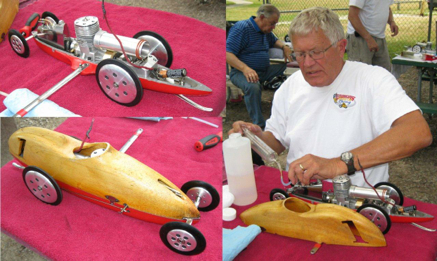
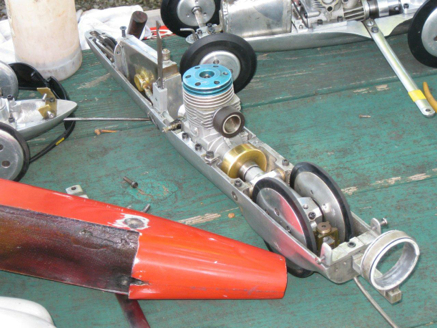
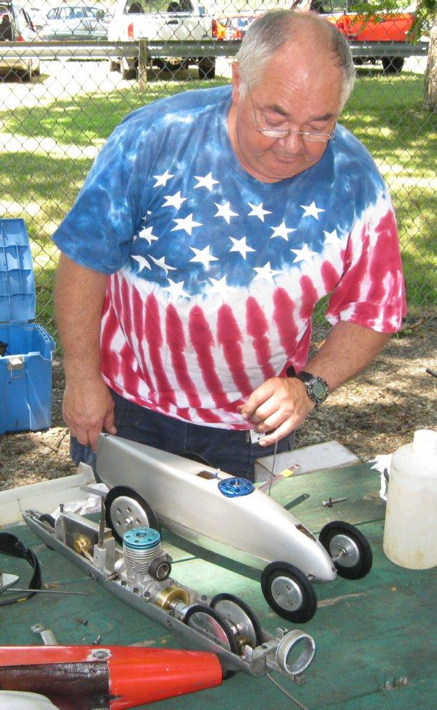
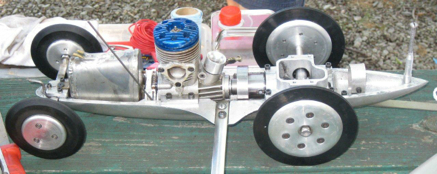
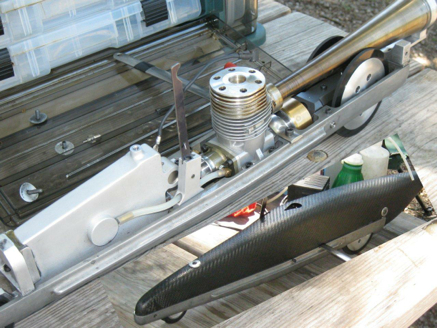
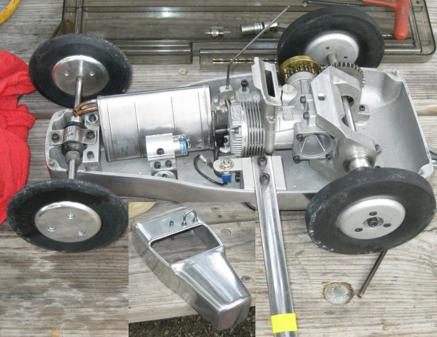
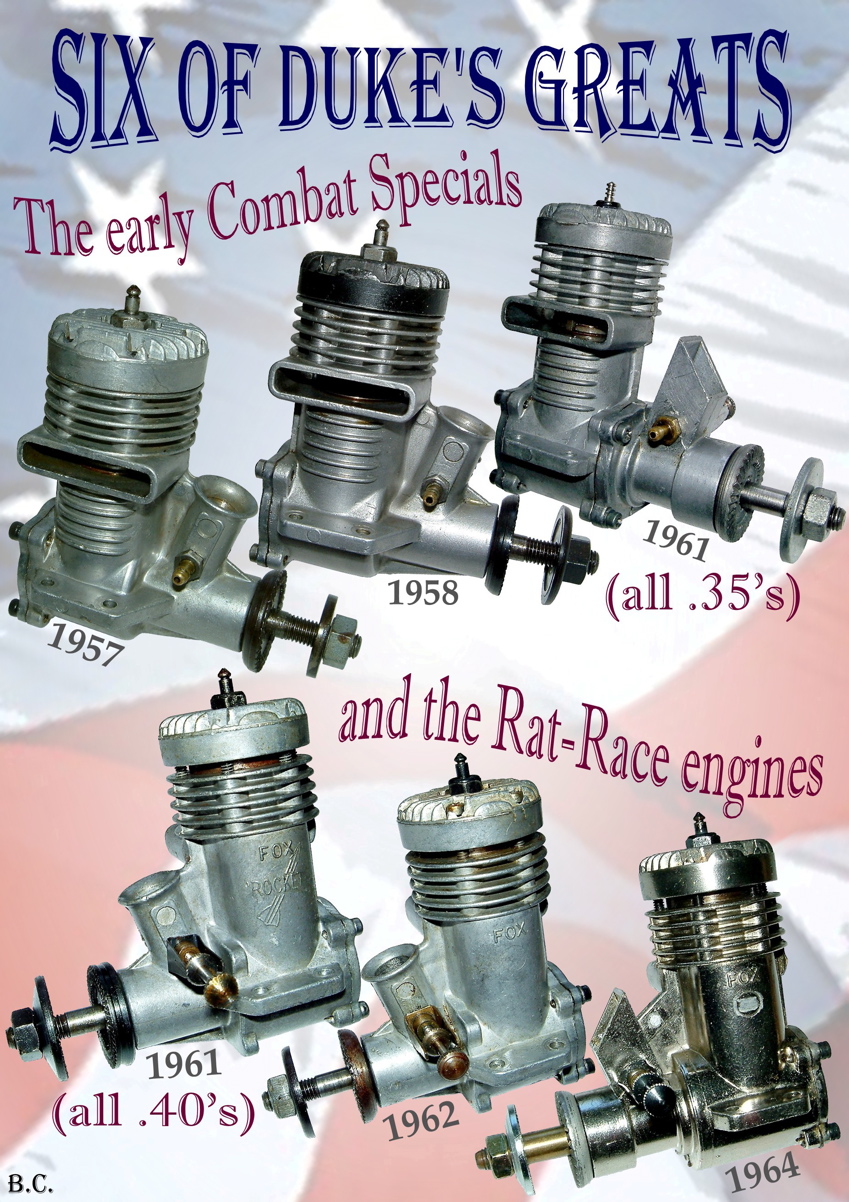
MECA's membership is comprised of individuals from around the world who enjoy model engine collecting, as well as collecting airplanes, cars, and boats from these pioneering years.  While the original emphasis was on engines, many members now concentrate on kits or completed models, or modeling memorabilia.  Most of these collectibles were produced before or just after WWII, but MECA is not limited to any particular time period.  One of the fastest growing areas within MECA is model cars, especially tether cars.

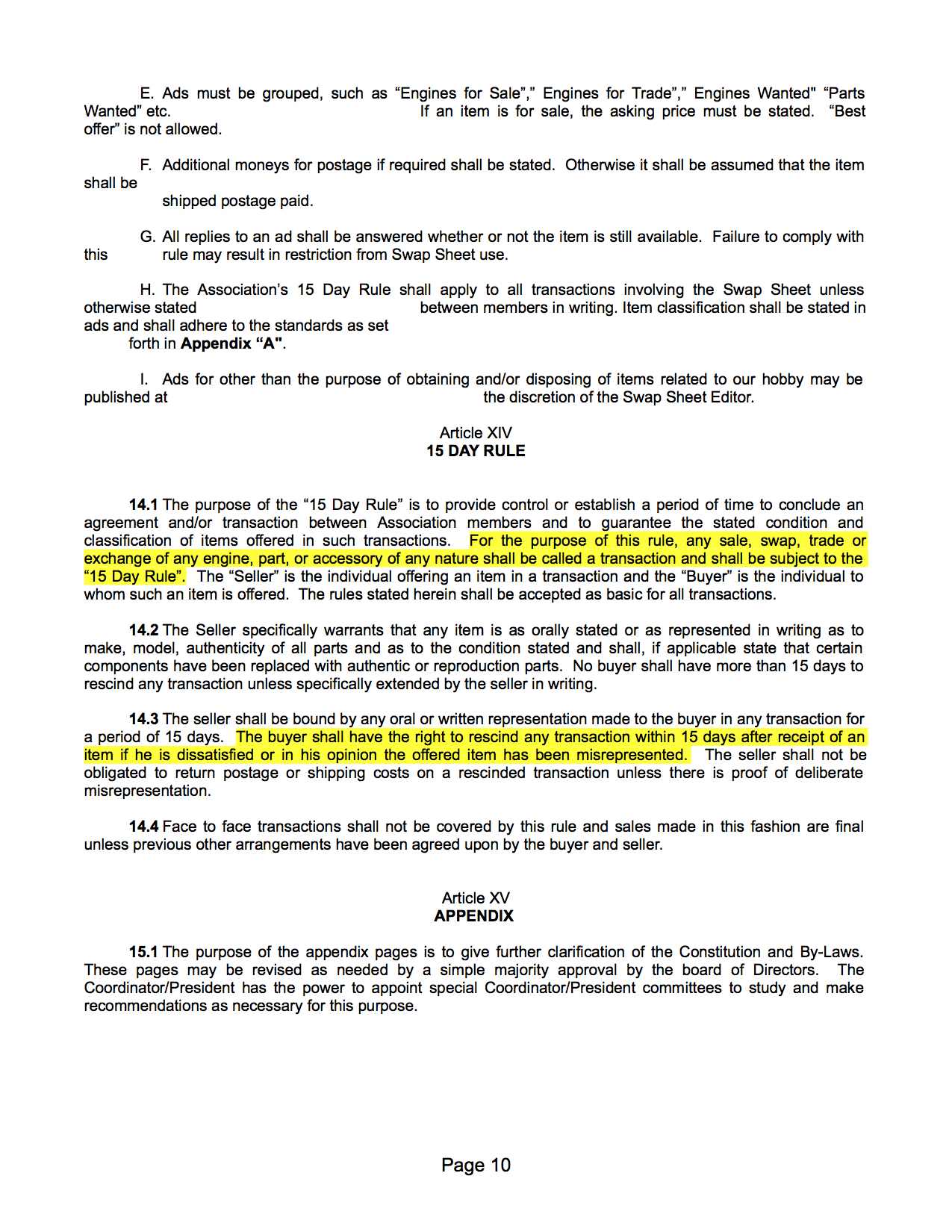
When dealing with other MECA members, you can do so with confidence.  MECA employs a 15 day rule, which applies to all transactions and protects both the buyer and seller by providing a means to settle trade disputes.  Under this rule, members have 15 days in which to evaluate a purchase.  If not satisfied, the item(s) may be returned for a refund.

The combined Swap Sheet and News Bulletin is published bi-monthly, both in printed form and on this web site, and is available to members only.  It provides a means to learn about and contact people with similar interests who will be able to help you:

Buy, sell, or trade antique model engines, kits, or completed models

Locate missing parts for engines or models you already have

Locate services that are available to aid in repair or restoration of your engines and models

Learn the history of the many lines of engines and models

Upcoming MECA Collectos


Region 1 Collecto

Region 2 Collecto

Region 3 Collecto

Region 5 Collecto

Region 8 Collecto

Join MECA


If you are interested in becoming a member of this exciting organization, download a Membership Application by clicking on the form below and saving the PDF version to your computer. Print it, fill it out, and return it with your dues to John Lorenz at the address on the form. You may also use a Credit Card or PayPal for this remittance. Use the Back Button on your browser to return to the Home Page after downloading the form.


Membership Dues Increase


At their annual meeting on September 11, 2009 in Muncie, IN, the MECA Board of Directors approved a membership dues increase of $5.00 per year, effective immediately. This action was necessitated because of reduced revenue as a result of declining membership, coupled with increased costs of mailing the Bulletin and Swap Sheet, primarily due to several recent increases in postal rates.

As a result of this action, membership dues are now $40.00 per year for members who reside in the US, $45.00 per year for members living in Canada and Mexico, and $60.00 per year for members living in all other countries.

A revised version of the Membership Application and Renewal form which reflects this new membership dues structure is included below.


John Lorenz
Treasurer


MECA Application

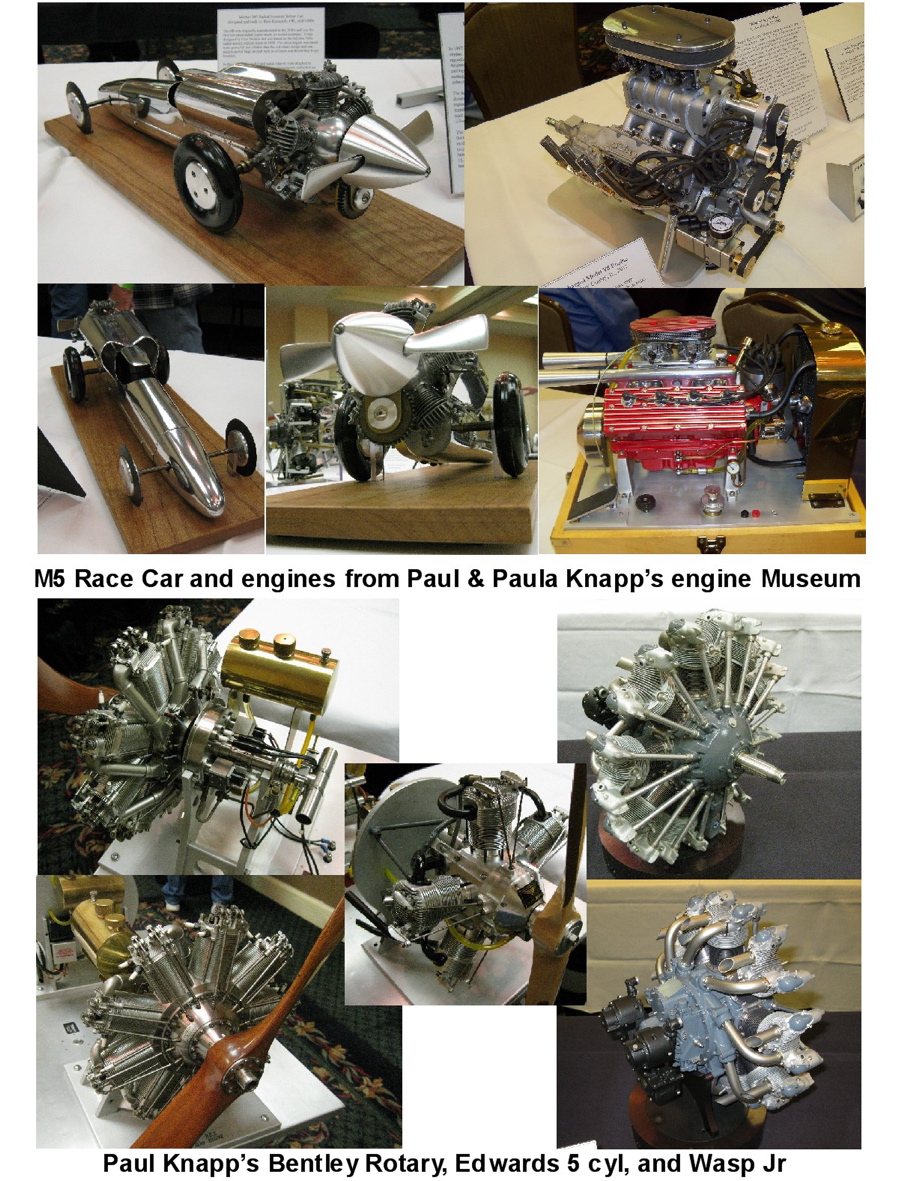
MINIATURE ENGINEERING MUSEUM - WHERE ENGINES GATHER


Paul Knapp


Mike Showah accompanied me to the WEME Show in Vallejo CA (in July) where we exhibited about 40 engines. Among them were eight engines designed and built by Alphonse Vassallo of the Bay Area Engine Modelers Club. Al passed away in November of 2008 and his daughter Cherise was intent on placing her father’s engines on exhibit where everyone had the opportunity to enjoy them. Al was quite innovative and inventive and even received a patent on one of his engines; Cherise wasn’t going to settle for her dad’s engines to remain at home in a dark room where no one could see them. She explained Al seldom visited the model engine shows, but was a regular at the club meetings and RC modeler’s flying sites where he enjoyed showing off his treasures. Although he seemed to favor the Stirling Cycle engines he was quite diverse in his design and building skills and produced several glow engines for boats and airplanes as well as a new proof-of-concept vane type rotary engine. Cherise contacted us last January after searching the Internet for someone who would be interested in displaying her father’s works. We, of course, were very excited for the opportunity and made arrangements to meet her in southern California to pick up her father’s engines in late May of 2009. The show in Vallejo was only 6 weeks away, but since Al lived in the Bay Area I felt obligated (and became somewhat obsessed) with preparing his engines for that show. It turned out to be a fine show and a great reunion of Al’s friends and family including Andre (his son) who flew in from Florida for the event. We wish to thank Al’s family for allowing us to display his wonderful works of art, but particularly Cherise; who placed the value of her father’s efforts above everything else and strove to keep his image alive and his works displayed for future generations to enjoy.

Bruce Underwood
Al’s “Flame Licker” Twin

Bruce Underwood
Al’s Stirling Cycle Engine

Bruce Underwood
Al’s Stuart Turner Twin

Bruce Underwood
Al’s Stirling Cycle V4

Bruce Underwood
Al’s Twin Stirling Cycle

Bruce Underwood
Al’s Vane Type Rotary

Bruce Underwood
Al’s Two-Cylinder Opposed

Bruce Underwood
Al’s 5-Cylinder Radial

Other engines we displayed were Lee Root’s fine masterpieces, a Henry Parohl radial engine, a Schillings inline 4-cylinder and a flat 6-cylinder DOHC engine, several British engines, and George Trimble’s first engine.

After the Vallejo show our entire display of 40 engines went to the Craftsmanship Museum in Vista CA where it was immediately placed on exhibit. If you get the opportunity please visit their site at: www.craftsmanshipmuseum.com to see these additions to their wonderful display of quality craftsmanship.

Lou Ross built many multi-cylinder model airplane engines including inline twins, flat twins, flat fours, and even flat six-cylinder engines. Little did we know that he designed and built this two-cycle, inline 4-cylinder model engine until it was presented to us by R. William Kent of Arizona. We feel honored to have this for display since all of the engine collectors we know (and particularly the Ross engine collectors) have never seen another example like it. There may be some explanation for that however. When we received the engine it had a broken tap in the set-screw hole that retains one of the carburetors. It may have been a prototype and it is doubtful Lou would have sold any engine with a broken tap so we are quite certain it never left his shop. Someone attempted to remove the tap (I believe that to be Lou) but gave up since it was impossible to remove mechanically. Perhaps he set it aside with the intention of getting back to it at a later date and, as in many cases, it fell through the cracks only to be forgotten. When we received the engine I spent many hours carefully reviewing the broken tap and developed a plan of attack to safely remove it from the engine. The entire engine was anodized black so it took three days of careful persistence to chemically remove it without affecting the anodizing or any other part of the engine. Then it took two more days to clean and restore it to new condition. Our thanks go to Gary Conley (Conley Precision Engines) who kindly contributed two new Perry carbs since one of the originals was missing; and our gratitude and thanks go to R. William Kent for his support and contribution of such a wonderful piece of miniature engineering history.

Bruce Underwood
Lee Root’s Corvette

Bruce Underwood
Lee Root’s DOHC 4

Bruce Underwood
Lee Root’s Model A Ford

Bruce Underwood
Lee Root’s 7-Cylinder Radial

Bruce Underwood
Parohl’s 5-Cylinder Radial

Bruce Underwood
Trimble’s First Engine

Bruce Underwood
Lou’s 4-Cylinder Inline

Bruce Underwood
Jim Riggle’s Midget DOHC 4

In September I received a message from Mike Gombert of Colorado Springs who called to let me know that his friend Ed Miller of Cody WO wanted to contribute a wonderful treasure that I never expected to see again in my lifetime. Back in the early 90’s Paula and I began to attend the NAMES show in Wyandotte MI. In either 1993 or 1994 we met Jim Riggle with his beautiful ¼-scale Midget racer fully equipped with his own custom made 4-cylinder DOHC racing engine. I didn’t have an opportunity to see it run but everyone who did said it was the best running inline 4 they had ever seen. Even though we attended the NAMES show and several other shows we never saw Jim again; sadly we learned last year that he passed away on April 14, 2008 at a young age of 73.

I had just I made the trip from Tempe to Payson on Tuesday September 15th when I received Mike Gombert’s telephone message. The message simply asked me to call him so I immediately grabbed the phone and returned his call. He told me a little about Jim Riggle and Ed Miller’s relationship and said Ed wanted to donate Jim’s car if we would be interested in it for our exhibits. He really caught me by surprise and what I heard must have taken about 30 seconds to absorb and decipher, but I suddenly blurted out a resounding ‘YES’ that I believe could have been heard in New York. He explained that Ed did not want to crate the car and trust the shipping companies to transport it so I would have to contact him directly to make arrangements to pick up the car. Mike proceeded to tell me that he and several engine builders from the Denver area were heading to the Black Hills show in Rapid City SD on Friday the 18th and that Ed Miller was driving in from Cody to meet them for a visit. He suggested maybe I could join them to attend the show also. Quickly I calculated the possibility and thought to myself- tomorrow is Wednesday the 16th. If I leave early enough on Thursday morning the 17th I could make Colorado Springs by Thursday evening. Then I could meet up with the guys on Friday morning and drive to Rapid City with them. I told Mike I would contact Ed and then get back to him on Wednesday morning.

I woke up Wednesday morning with the nasty thought that the brakes on my van were squeaking on the way up the hill to Payson. Wasn’t that they were dusty either; just worn out. I probably couldn’t get them fixed in time for the trip so I gave up on the idea to travel, but decided to call Ed to introduce myself and visit on the phone for a while. Ed was pretty excited about our interest in preserving Jim’s car and as we conversed the gears began turning in the back of my mind. I just had to figure out a way to get to that show and, before we hung up, I committed and told Ed I would meet him at the show; and he agreed to bring Jim’s car.

I knew I couldn’t make a 2000 mile trip on my brakes so I immediately called an acquaintance in Payson who owned a mechanics shop to see if there was the slightest possibility to get my van fixed within the day. He laughed and said (jokingly) I took priority because I am the best friend of his Landlord- and if I brought it in right away he would finish it by noon. I wasted no time getting the van to his shop and, as he promised, it was finished by noon. In the meantime I called Mike and told him I planned to be in Colorado Springs by Thursday evening and we could meet up Friday morning. Everything was set. I was not mentally prepared for the long drive but I was excited about visiting the guys from the Springs and meeting new (and old) friends at the Black Hills Show.

The show was small but had a lot of very interesting engines and engineering projects. I spent every available minute visiting those I haven’t seen for a several years and meeting with new friends but, like all shows, it was over in a flash and it was time to go back home.

The memories of that show will last forever because I got to know more about Jim Riggle through his best friends Ed Miller, Wayne Kilber and, of course, Mike Gombert. Wayne kindly provided a lot of information and some very interesting video footage of Jim running his Midget racer on radio control. Mike offered to share his memories of their friendships and the means to bring us all together at the Black Hills Show. Ed provided us with the prize- this wonderful piece of mechanical art. Jim’s Midget racer needs a bit of restoration, but it is a masterpiece of design and engineering and a wonderful addition to our collection. We are proud for the opportunity to exhibit his work and want to thank Ed Miller for his thoughtfulness and contribution. I can only imagine the fun it must have been to be a part of their group for so many years.

Scott Hord of Arizona surprised us with his contribution of a Lucas & Smith single cylinder airplane engine from the early days of spark ignition engines. Scott designed and built his own ultra-light airplane and engine; he also builds model engines, and flies both model and ultra-light airplanes. Our thanks go to Scott Hord for his support and contribution to our Miniature Engineering Museum effort. Keep up the good work in your ultra-light and model engineering and fly safely.

Bruce Underwood
Lucas & Smith .60 Model Airplane Engine

A Brief History By: Bill Bickel

MECA Historian

November 2007


Small internal combustion engines have been around for a long time. In the US they date back to at least the early 1900s. The first ones were fairly crude and best suited for use as marine or stationary power plants. They were often built by their owners or by one of hundreds of small companies, many of whose advertisements were often on the optimistic side of reality. Prior to this the only other real choice for power was rubber bands, steam or hot air (Stirling Cycle) engines although there were examples that used materials like carbide or even gunpowder for fuel.

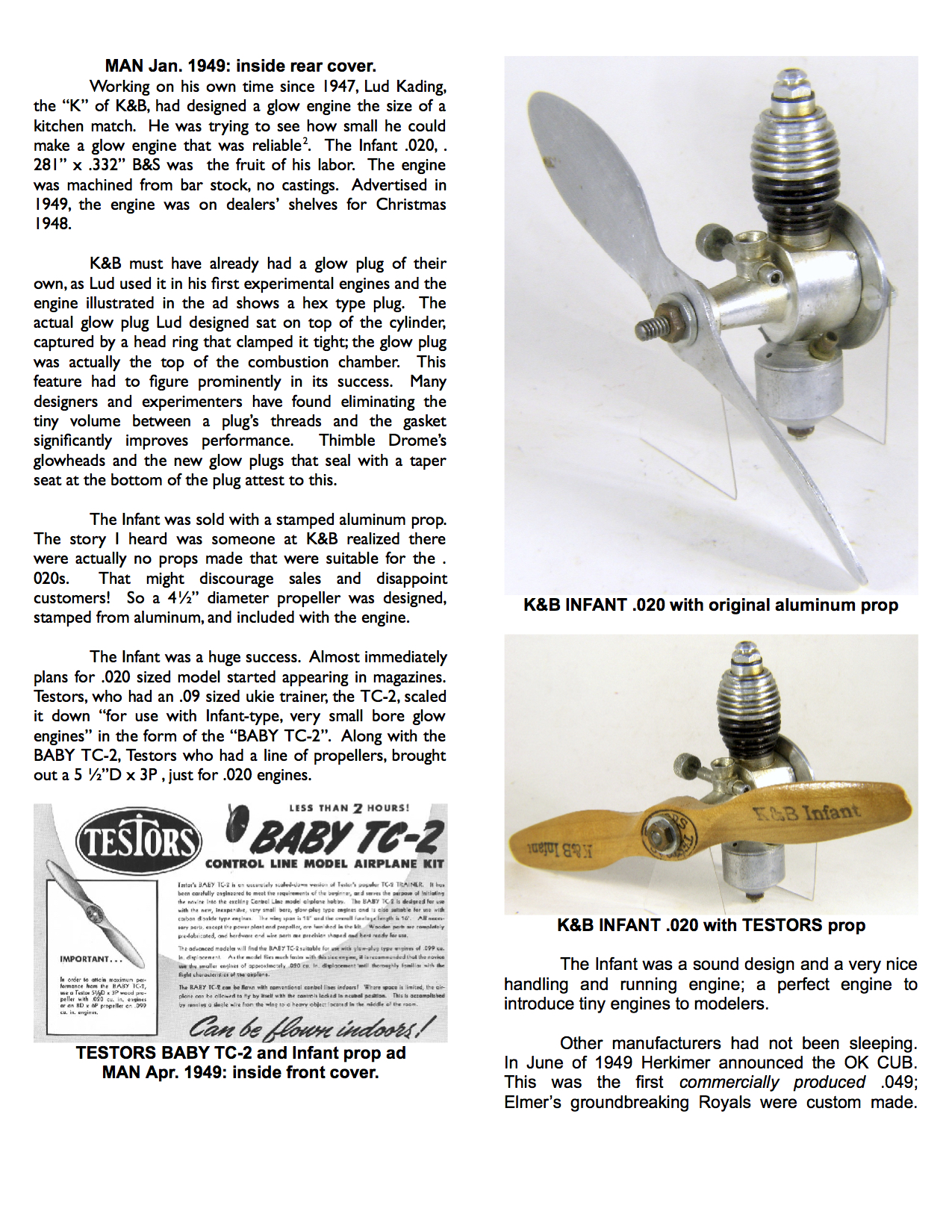
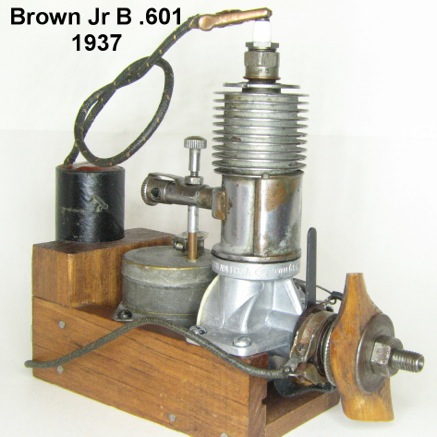
In the 1930s, William Lykens (Bill) Brown IV of Philadelphia, PA Developed the first small engine suited for powering model planes. Several models of this .60 cubic inch displacement "Brown Jr." engine were produced over the next 10 years or so with over 50,000 being made. These engines used an ignition system similar to that found on automobiles of the era, which meant that a model must carry a spark coil, condenser and batteries along with a fuel supply for its engine. Many of the original Brown engines are still in use and are sought after by engine collectors and modelers who still use them to power their models. Since then, there have been model engine companies with production figures running into the millions of units.

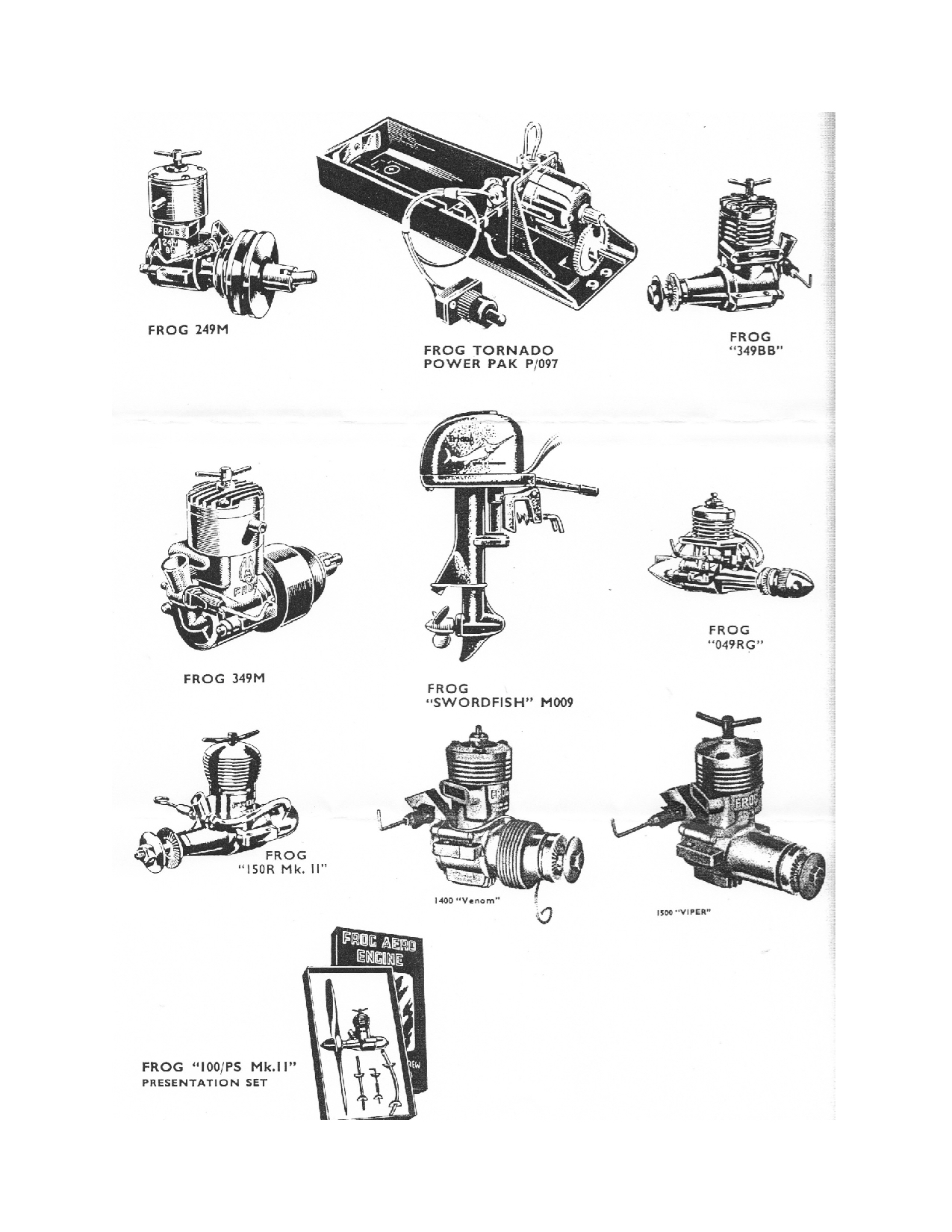
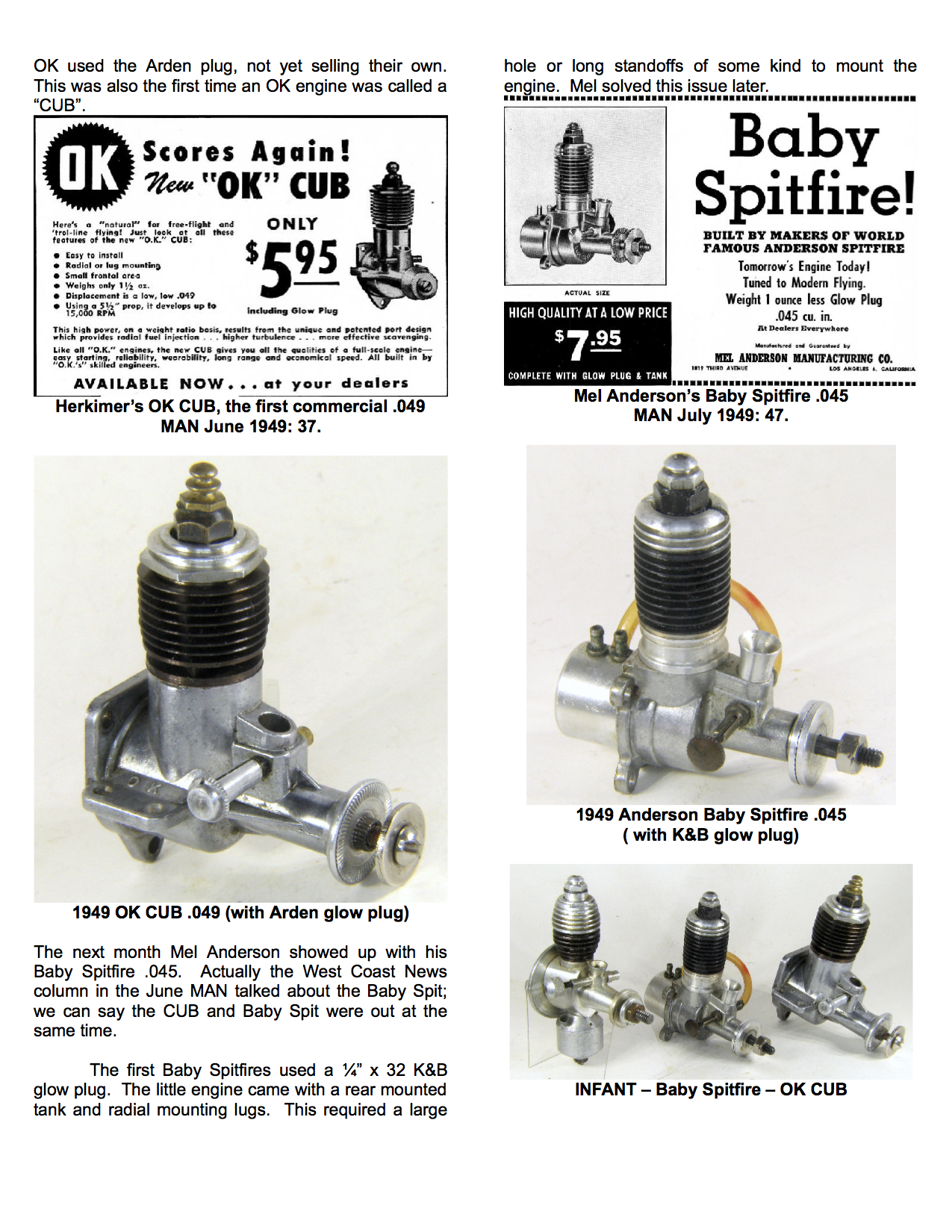
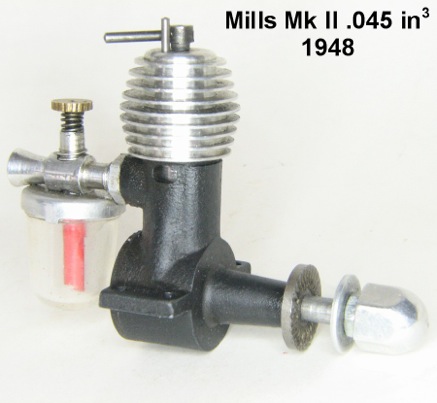
The little power plants that we collect were for the most part intended to power model planes, cars or boats. They come in many sizes and configurations with most of them being 2-stroke one cylinder engines ranging in size from less than .01 to several cubic inches in displacement. The majority of them (at least in the US) use a spark plug or a glow plug for ignition but there are also diesels, various types of jet engines and some little power plants that are powered by compressed air or carbon dioxide carried in a small storage tank.

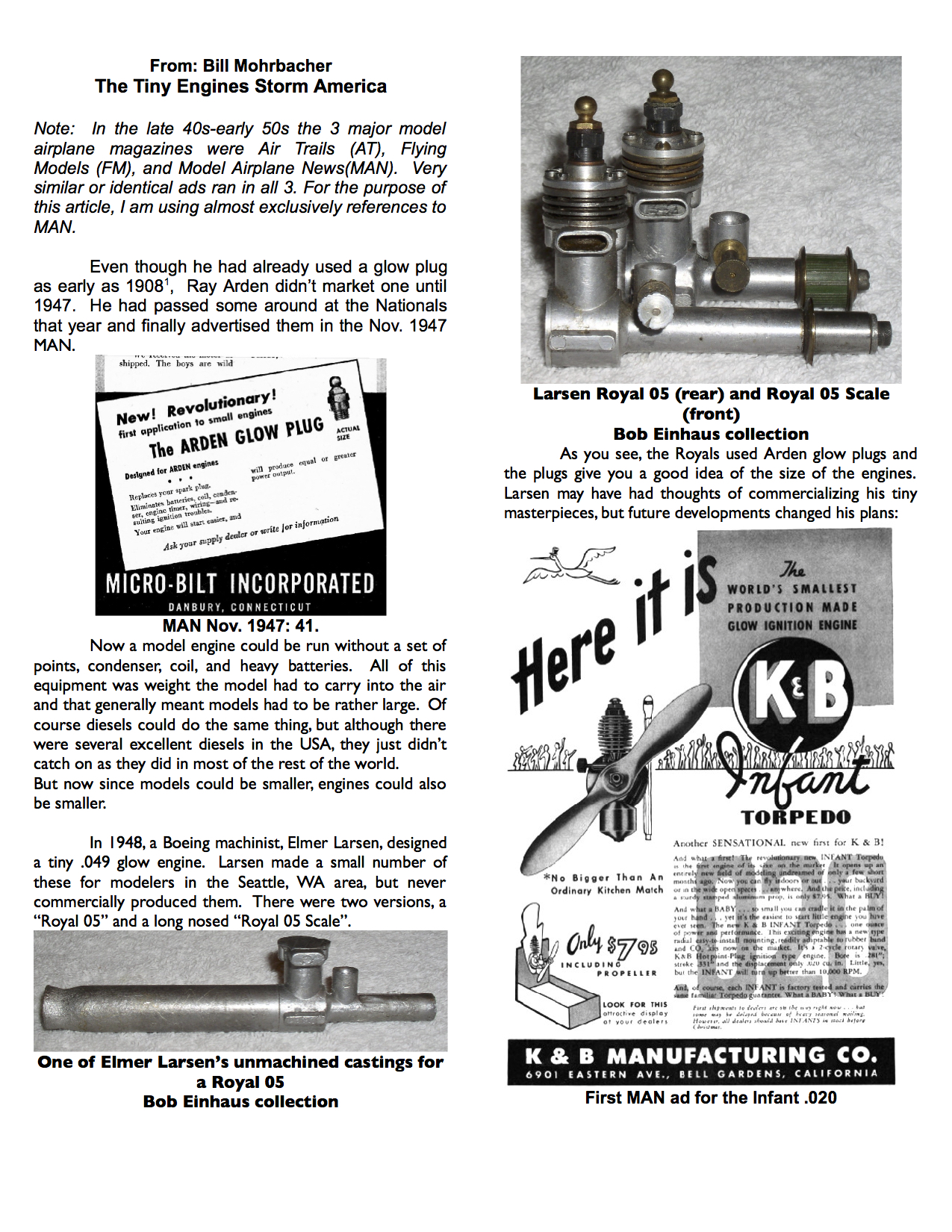
MECA had its beginnings in the mid 1950s when Bruce Underwood, who may well be known better for his "Yellow Jacket" engines, started circulating a newsletter among a few friends who were interested in preserving the spark plug ignition engines that were rapidly disappearing due to the introduction of the Glow Plug by Ray Arden.

Bruce Underwood
Bruce Underwood

Bruce acted as the focal point for gathering information for the engine collectors that were known at the time. He kept track of what each collector wanted and had to offer in exchange. He also suggested systems for marking and cataloging engine collections. The group grew to about 17 members.

In January 1960, the groups members were asked to submit names for the organization. Bruce suggested the winning name. MODEL ENGINE COLLECTORS ASSOCIATION (MECA) was adopted as the groups name the following month.

Starting in 1960, Joe Wagner took over MECA when Bruce had to step down due to his workload. During the 1960-1961 period Joe produced the four "Model Engine Collector" newsletters which were called "The Official Journal of the Model Engine Collectors Association" and the "Index of American Model Engines" which listed over 700 engines known at the time. This material is considered to be the first volume of what is now the "Engine Collectors' Journal" (ECJ) which was to begin publication in 1963 and is still being published by Tim Dannels. The first MECA officers were named during this period. The membership at this time probably reached 25-30 people.

In 1963 Allen Shively took over and started reviving MECA which had become nearly inactive. During 1963 and the first half of 1964 The first issues of the ECJ became the "Voice of MECA" through Allen's "MECA NOTES" column. By May 1964 MECA membership had reached 115, the country had been divided into 11 MECA regions and the first Regional Directors were selected.

The first MECA BULLETIN was published by Allen in March 1964. This publication contained MECA club related information and a schedule of upcoming events as well as reports on past events and information that would be useful to those wanting to repair and/or restore their engines. The earliest MECA Bulletins also contained lists of items wanted & available for sale or trade by MECA members. In 1964, this list was moved to a separate publication.

The first MECA SWAP SHEET was published in March 1968 by then national coordinator Karl Carlson. It listed engines and parts wanted and/or available for sale or trade by MECA members as well as other hobby related information.

In late 1968 a design for the MECA logo which was selected from a entry submitted by Ben Fox appeared on the cover of MECA Bulletin #23.

In February 1969 the name "Collectogether" (usually shortened to "Collecto") was coined by Jim Dunkin at an engine swap meet taking place at his home.

Over the years, MECA members discovered that socializing had become an important part of the engine collecting experience. In mid 1972 Tim Dannels had a line of MECA logo jewelry made up which was offered for sale to MECA members.

MECA Jewelry

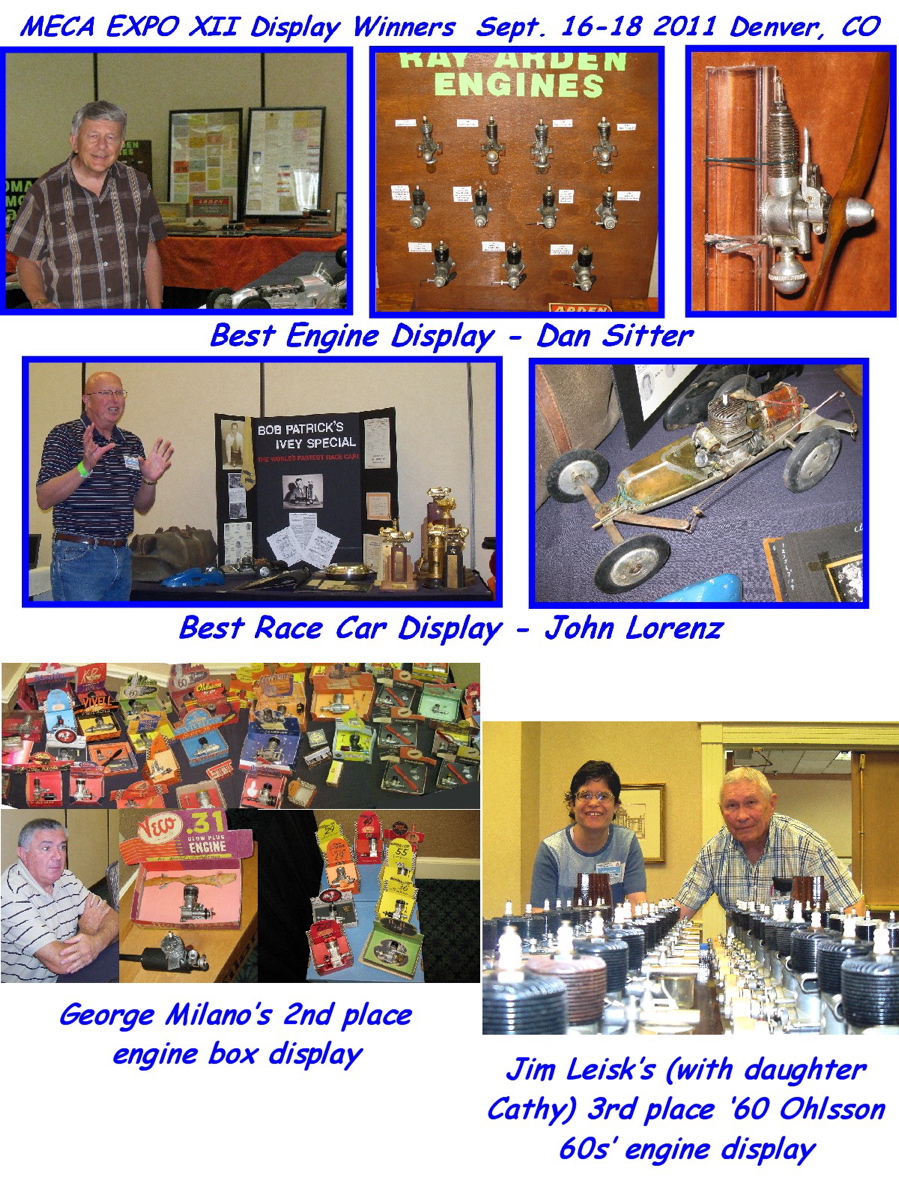
The first National Collectogether, which was arranged by The Society of Antique Modelers (SAM), was held at the 1971 SAM CHAMPS in Denver, Colorado. Later this was to be called the "Grand National Collectogether" which was promptly shortened to "GRANDO". SAM continued to help arrange the GRANDO event for many years.

In 2000, MECA decided to take over all aspects of holding the National Collectogether. This new event is called "EXPO"

EXPO is much more than a collecto, it has been expanded over several days to include symposiums, guest speakers, a banquet with entertainment, functions for the ladies and in some cases a contest.

EXPO is currently held the weekend just prior to the SAMCHAMPS in years when the SAMCHAMPS take place in Muncie, Indiana. On alternating years, EXPO will also take place in Muncie on a date that will allow MECA and SAM members to attend both events. In these years EXPO will be followed by the MECA sponsored MIDWEST CHAMPS contest.
In July 2000, MECA was adopted by The ACADEMY of MODEL AERONAUTICS (AMA) as a SIG (Special Interest Group).

In late 2002 the MECA BULLETIN and the MECA SWAP SHEET were combined into a single bi-monthly publication which typically is about 60 pages in length.

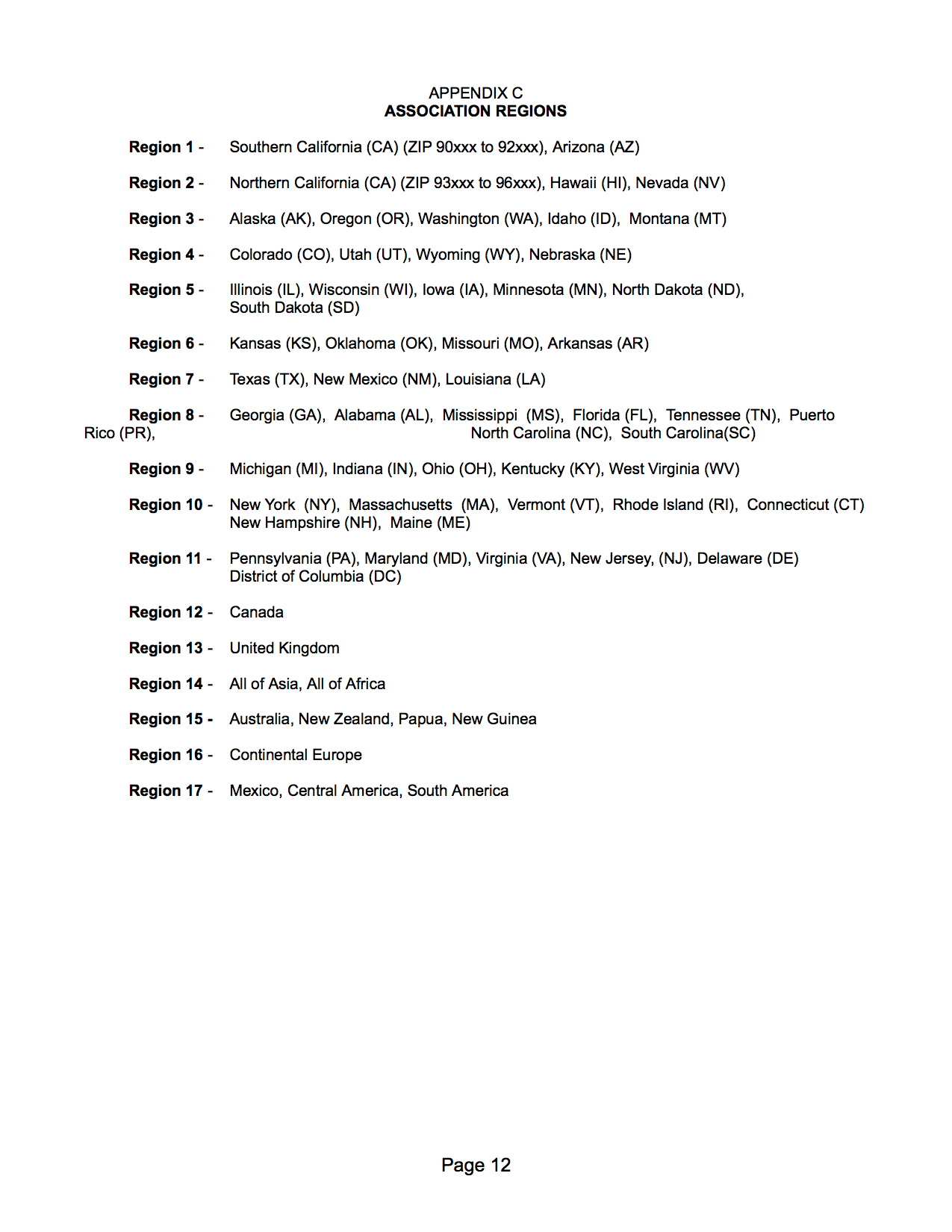
Today MECA is worldwide with members in the US and over 20 foreign countries, some of which have become MECA Regions. Over 5000 people have joined MECA to date and over 1000 of them are currently active.

MECA Member Services List


This is a listing of providers and the services they offer to the membership. I will update this list as new material comes in. Please notify me of any changes, errors, or omissions so that I can keep this list up to date. Send all adds to: Bill Bickel, 3121 W Cavedale Dr. Phoenix, AZ 85083-8637. DO NOT SEND ADS TO ANY OTHER PERSON. DEADLINE is ONE WEEK PRIOR to SWAP SHEET DEADLINE.


ANTIQUE REPRODUCTION MODEL AIRPLANE ENGINES: Woody's Model Engines   3706 N. 33rd St.   Galesburg, MI 49053-9715   Tel/FAX: (269) 665-9693   Website: www.woodysengines.com/  Catalog: $15.00 anywhere is USA. Canada and Mexico $16.00 International $22.00.


REPRODUCTION ANTIQUE IGNITION MODEL ENGINE PARTS: Aero Electric   3706 N. 33rd St.   Galesburg, MI 49053-9715   Tel/FAX: (269) 665-9693   E-mail: aeroelectric@charter.net  Catalog: $15.00 anywhere is USA. Canada and Mexico $16.00 International $22.00.


ENGINE COLLECTOR'S JOURNAL INDEX: Bill Bickel   3121 W. Cavedale Dr.   Phoenix, AZ 85082-8637   Tel: (623) 582-0211   E-mail: wbickel@msn.com


HELICOIL REPAIR of STRIPPED SPARK PLUG HOLES (¼-32 only), REPAIR 0F 4-40 & 6-32 HEAD and BACK COVER HOLES, GENERAL MACHINE WORK: C.F. Lee Mfg. Co.   10112 Woodward Ave.   Sunland, CA 91040   Tel: (818) 526-9074


DIE-CUT GASKETS for ATWOOD, WASP, & WEN-MAC .049'S $5.00 / set ppd: Bill Schmidt   4647 Krueger   Bel Aire, KS 67220   Tel: (316) 744-0378


EXPERT WELDING of ALUMINUM, MAGNESIUM and IRON, CRANKCASES, SPEED PANS, TIMER ARMS, Etc: ALLWELD/Scott Dinger   1367 Patricia Ave.   Simi Valley, CA 93065   Tel: (805) 526-9074   E-mail: hyflo@dslextreme.com


ENGINE RESTORATION, REPAIR and CLEANING SERVICES, NICKEL PLATING, TUMBLE POLISHING: Walter Craig   3664 Smoketown Rd.   Glenville, PA 17329   Tel: (717) 229-2840   E-mail: makenewagain@yahoo.com


MECOA's Model Engine Enthusiast Resource Site:   Randy Linsalato   P.O. Box 98   Sierra Madre, CA 91025   Tel: (800) 359-6972   Website: www.modelengine.org


ANDERSON'S BLUE BOOK: 1500 engine listings 1911-2005 The Collector's Bible with Pricing. Frank Anderson   817 9th Line, Innisfil, Ontario, Canada,   L9S 3Y2   Website: www.andersonbluebook.com   Tel/FAX: (705) 436-1970


MODEL ENGINE REFERENCE MATERIAL: American Model Engine Encyclopedia - Engine Collectors' Journal Tim Dannels   P.O. Box 243, Buena Vista, CA   81211   Website: www.modelenginecollecting.com


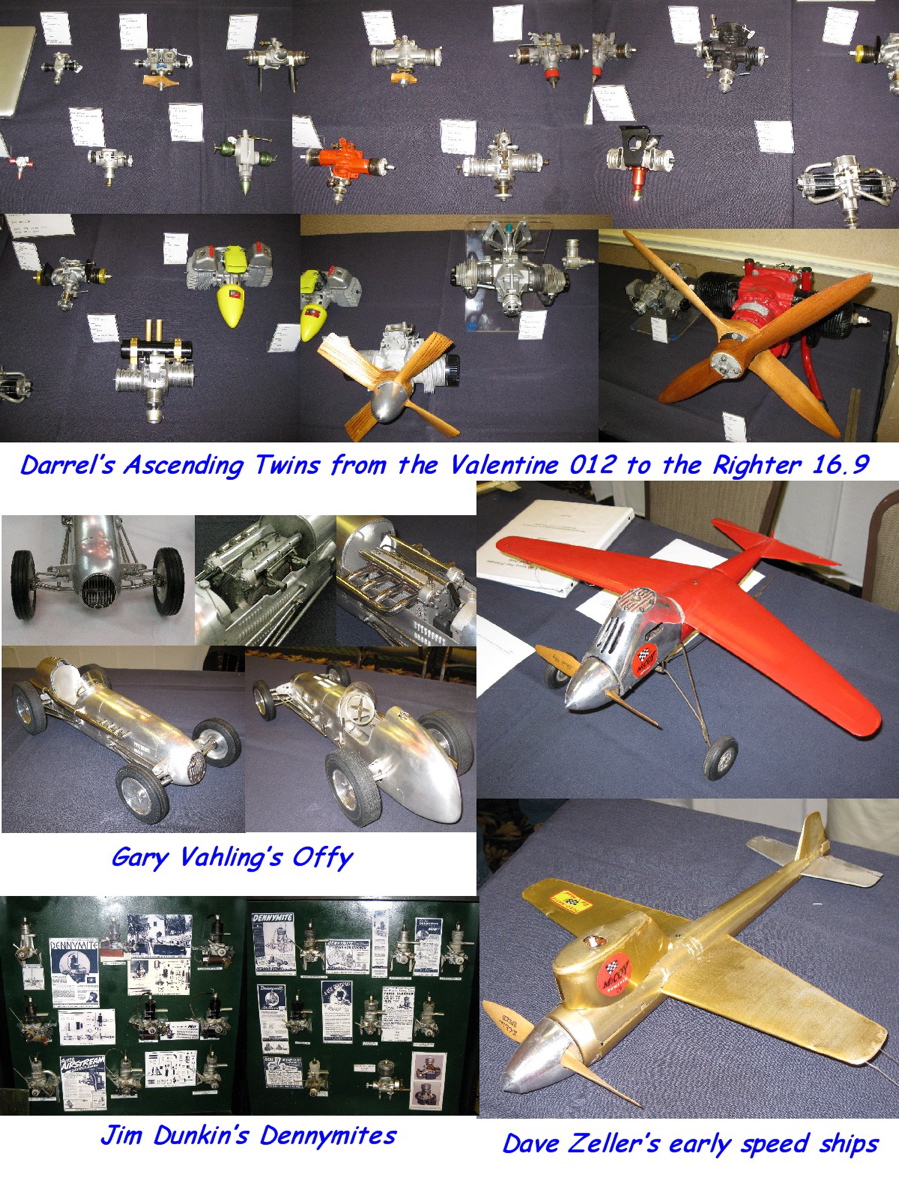
DENNYMITES DRONES & MORE: Info on Sky Charger, Dennymite, Walter Righter, Reginald Denny, Dooling Brothers & much more.   $60.00 + $6.00 P&H. Jim Dunkin   P.O. Box 695,   Grain Valley, MO   64029   E-mail: dunkin@discoverynet.com

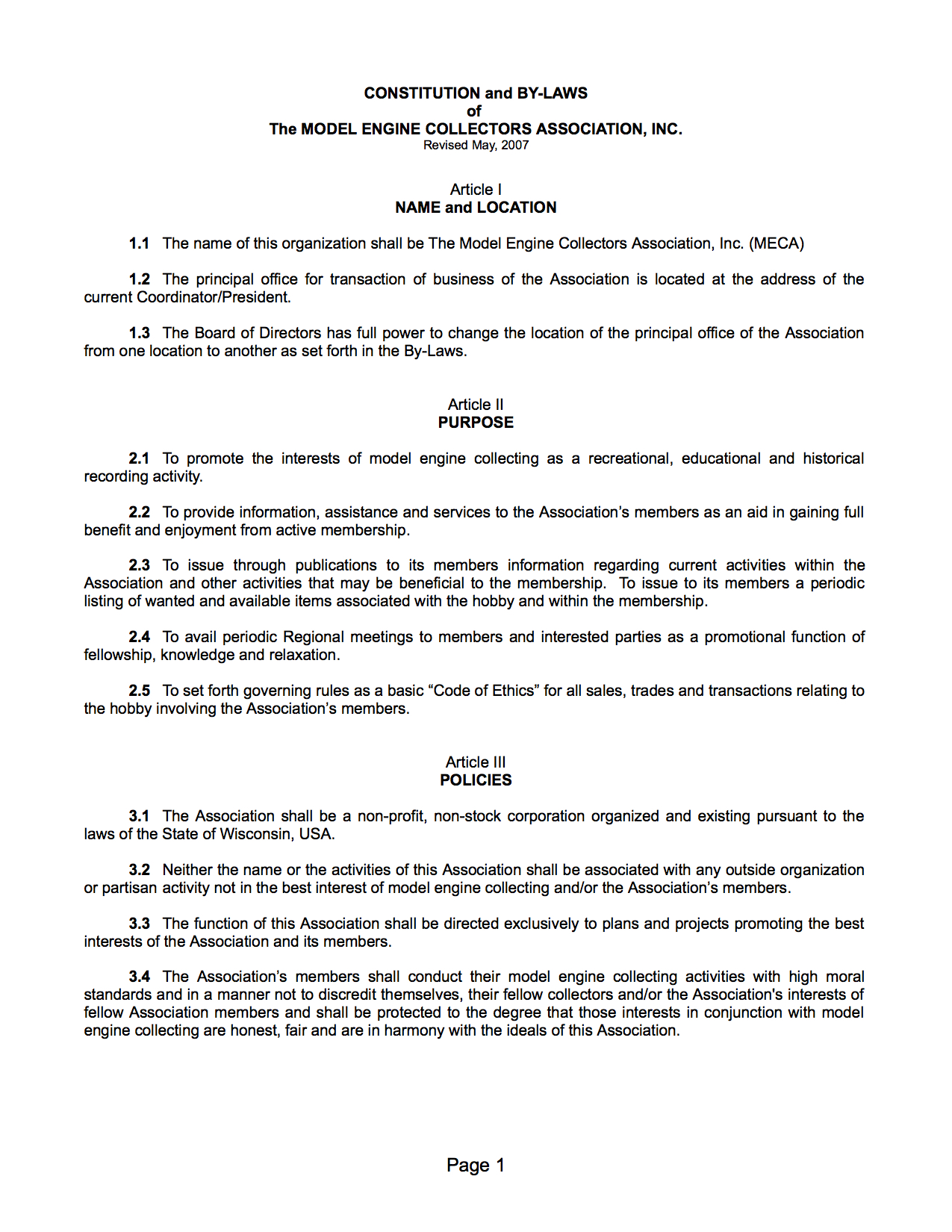
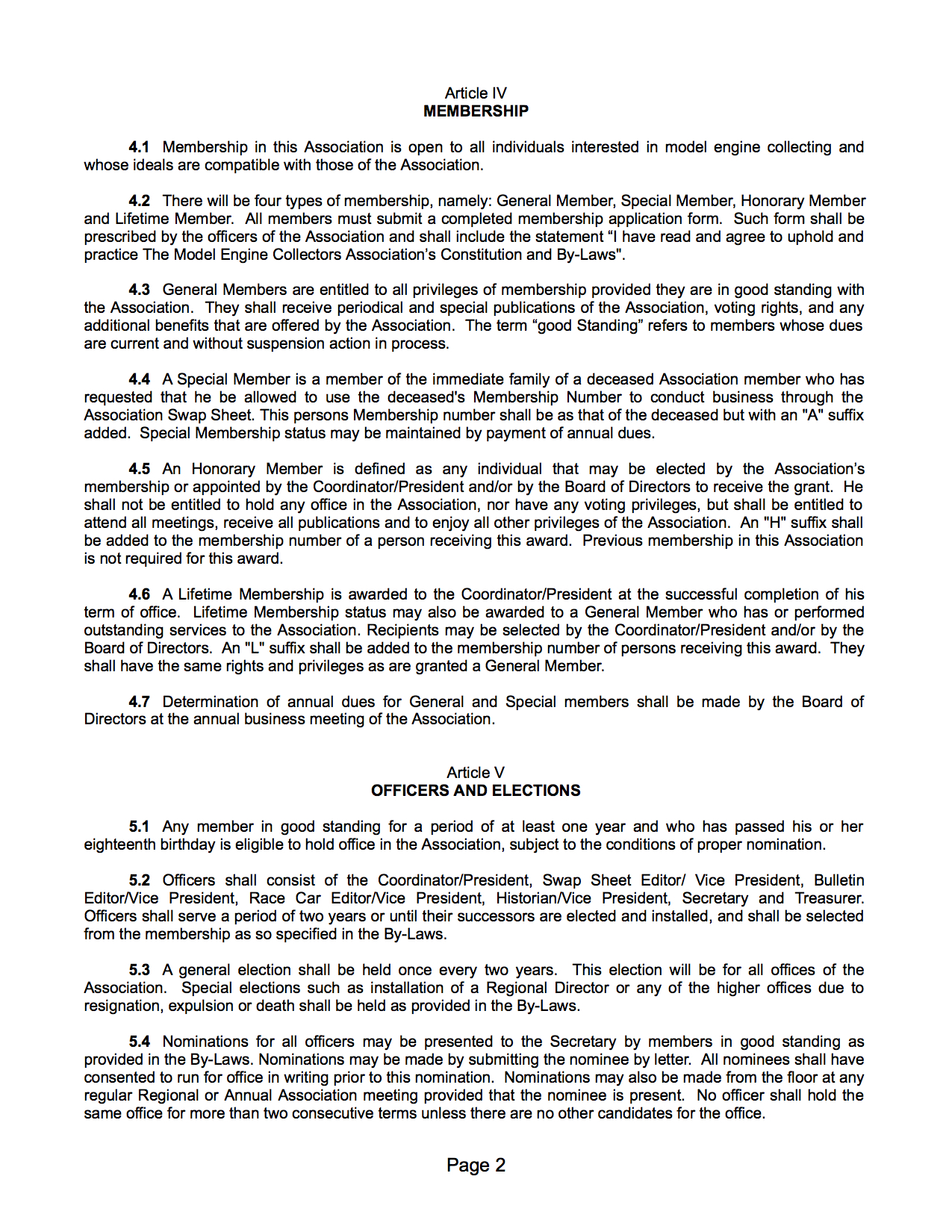
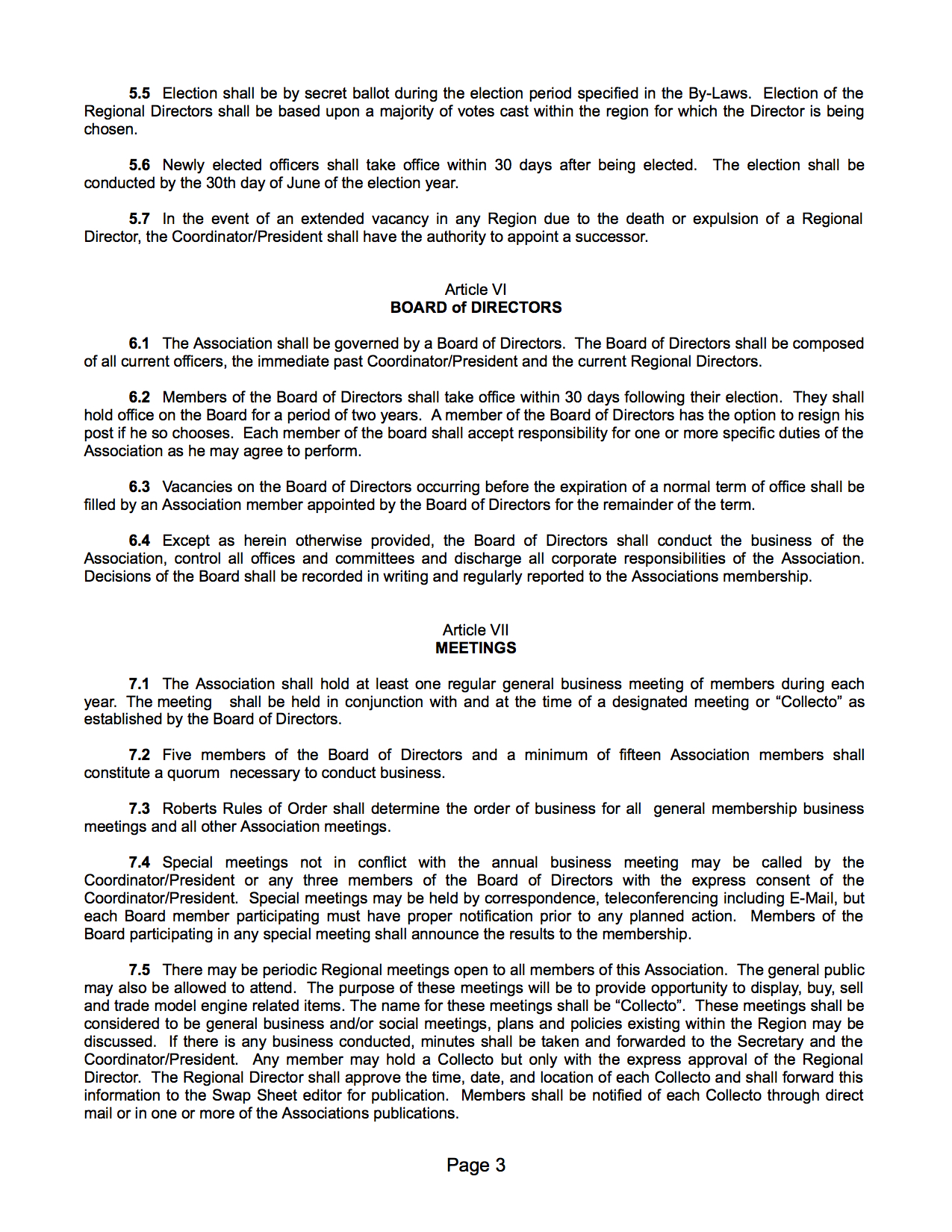
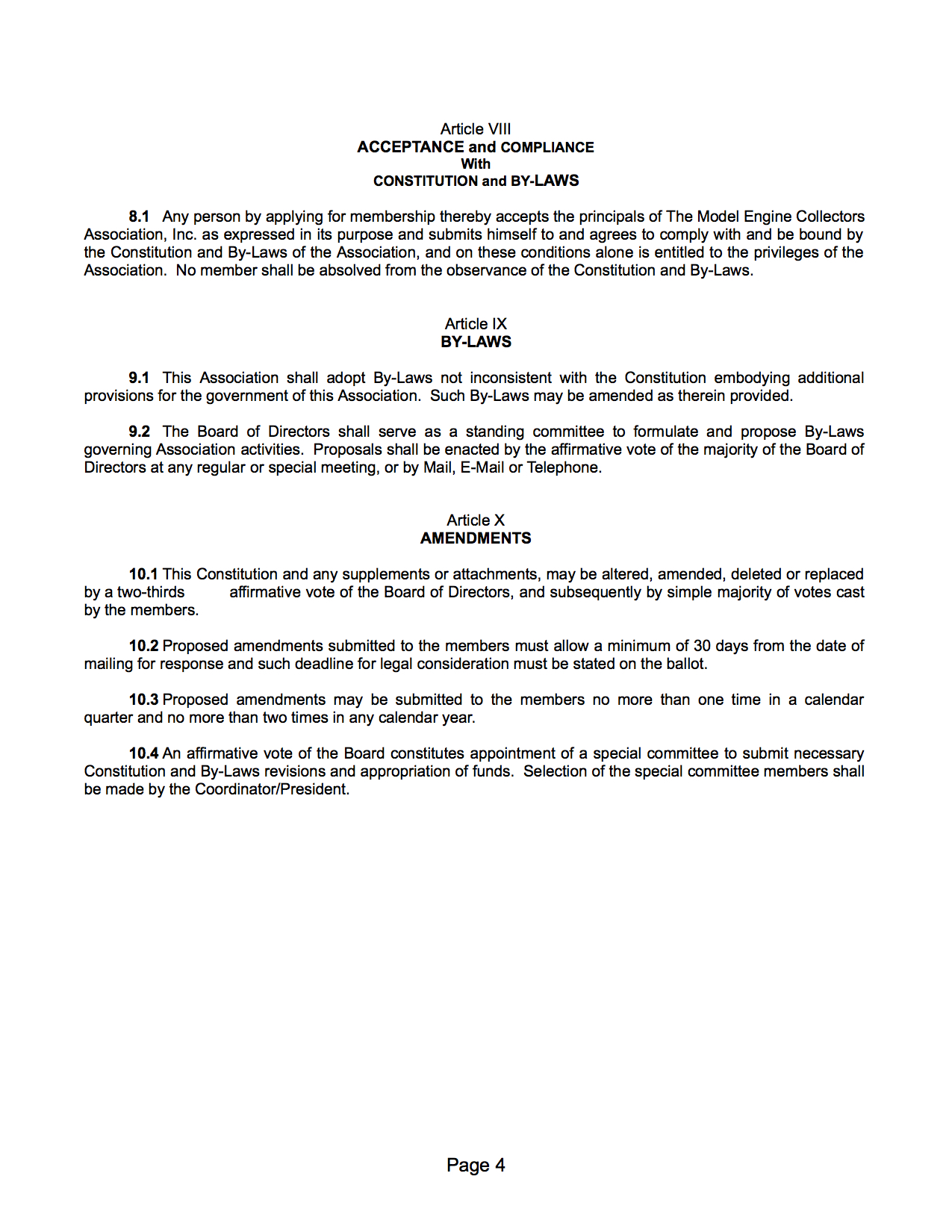
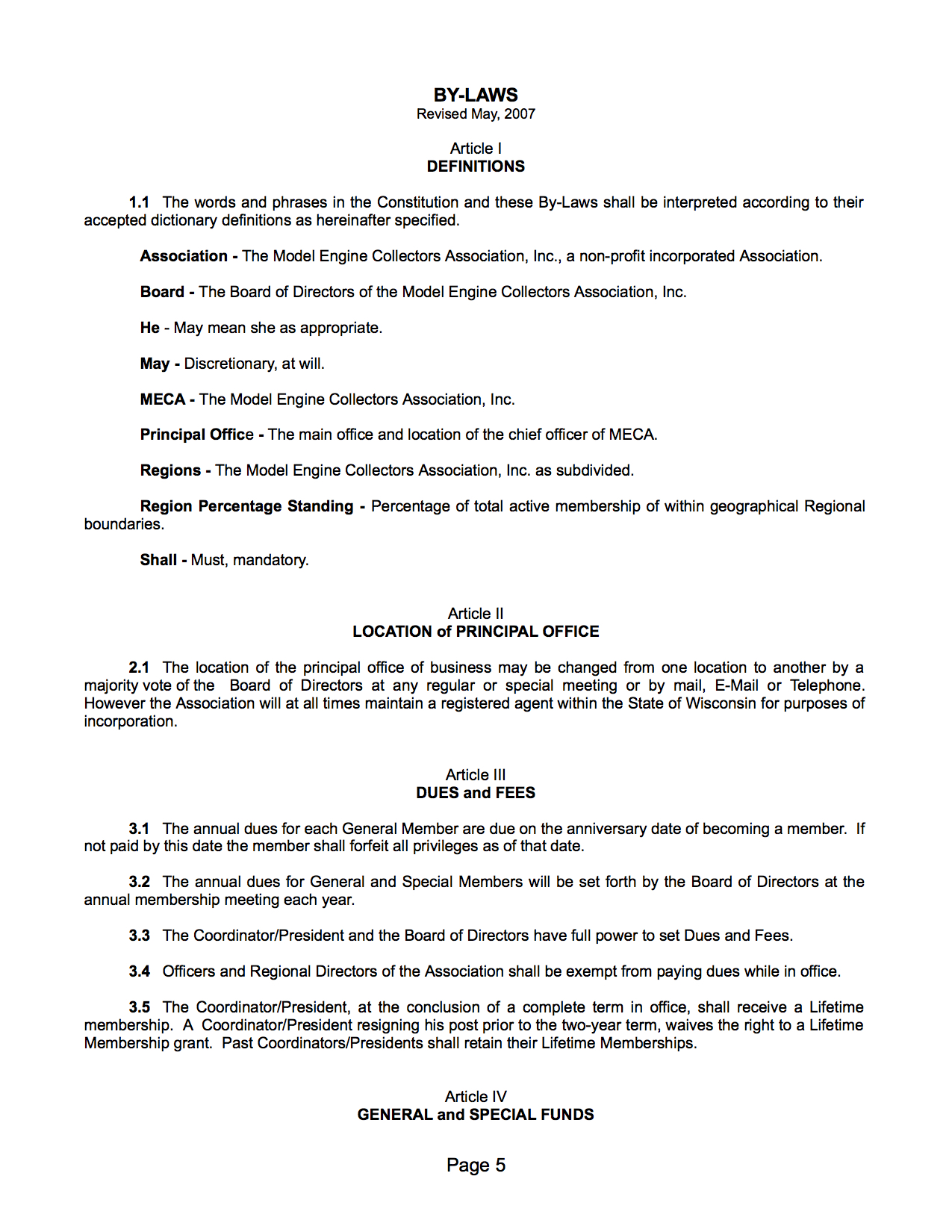
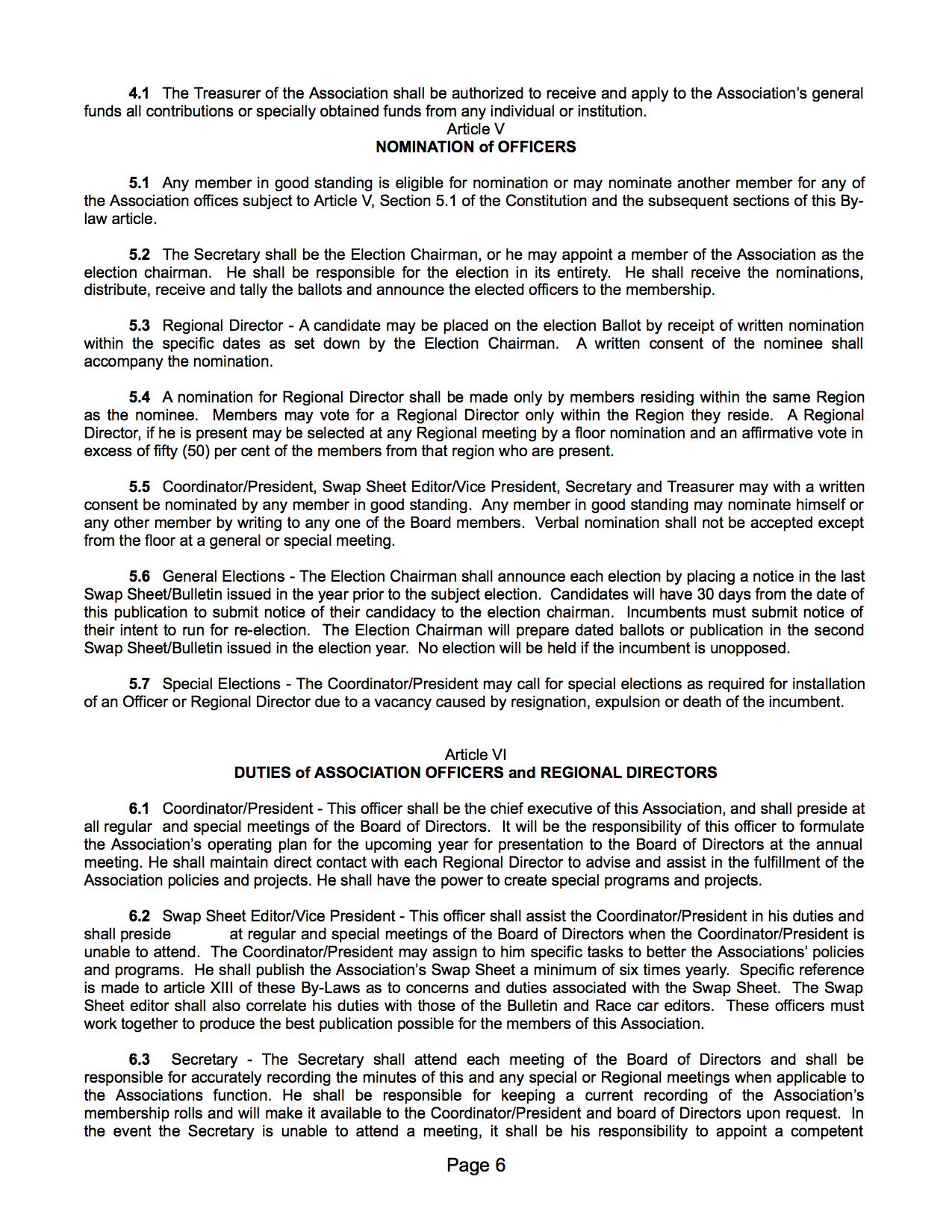
MECA Constitution & By-laws


All transactions occurring between MECA members are controlled by the By-laws of the organization. This ensures that any exchange is controlled and members may trust that the item they are purchasing or trading for is exactly as advertised. Buyers have 15 days in which to inspect their purchase. If not satisfied, the item may be returned for a full refund. If you would like more information on MECA and how it is governed, you may read the Constitution & By-laws in their entirety.

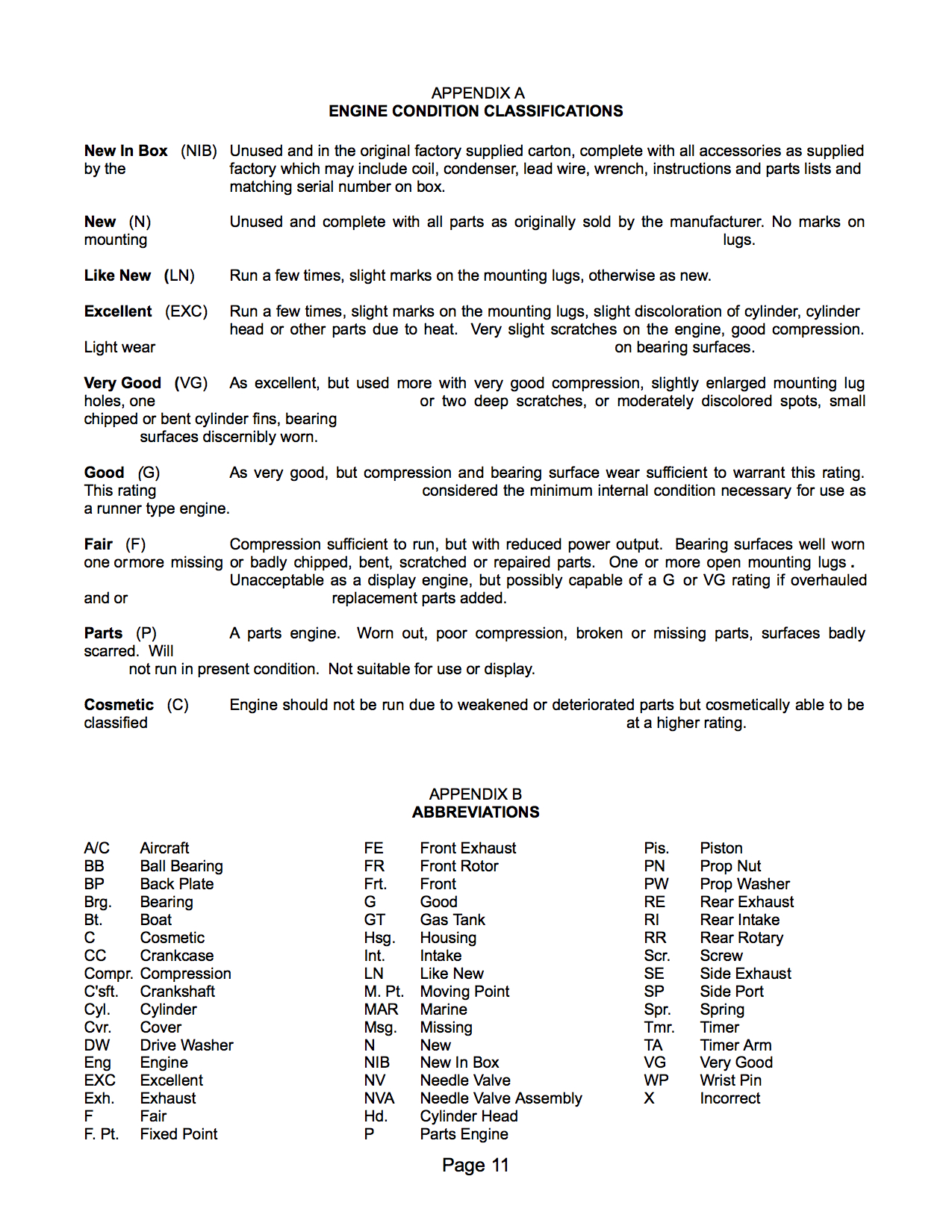
As a convenience, Appendix A of the Constitution & By-laws, covering engine condition classifications, is presented below. The use of these classifications helps to ensures honest exchanges.


APPENDIX A ENGINE CONDITION CLASSIFICATIONS
New In Box (NIB)
Unused and in the original factory supplied carton, complete with all accessories as supplied by the factory which may include coil, condenser, lead wire, wrench, instructions and parts lists and matching serial number on box.
New (N)
Unused and complete with all parts as originally sold by the manufacturer. No marks on mounting lugs.
Like New (LN)
Run a few times, slight marks on the mounting lugs, otherwise as new.
 
Excellent (EXC)
Run a few times, slight marks on the mounting lugs, slight discoloration of cylinder, cylinder head or other parts due to heat. Very slight scratches on the engine, good compression. Light wear on bearing surfaces.
Very Good (VG)
As excellent, but used more with very good compression, slightly enlarged mounting lug holes, one or two deep scratches, or moderately discolored spots, small chipped or bent cylinder fins, bearing surfaces discernibly worn.
Good (G)
As very good, but compression and bearing surface wear sufficient to warrant this rating. This rating considered the minimum internal condition necessary for use as a runner type engine.
Fair (F)
Compression sufficient to run, but with reduced power output. Bearing surfaces well worn one or more missing or badly chipped, bent, scratched or repaired parts. One or more open mounting lugs. Unacceptable as a display engine, but possibly capable of a G or VG rating if overhauled and or replacement parts added.
Parts (P)
A parts engine. Worn out, poor compression, broken or missing parts, surfaces badly scarred. Will not run in present condition. Not suitable for use or display.
Cosmetic (C)
Engine should not be run due to weakened or deteriorated parts but cosmetically able to be classified at a higher rating.

Links


Organizations


SAMSociety of Antique Modelers (SAM)

NFFSNational Free Flight Society (NFFS)

AMAAcademy of Model Aeronautics (AMA)

Race Car American Miniature Racing Car Association (AMRCA)


Engine Sales


Woody's Model Engines (Woody Bartelt)

Aero Electric (Woody Bartelt)

Doctor Diesel (Eric Clutton)

MECOA (RJL Engines) (Randy Linsalato)


Interesting Sites


Moyer Made Chevy V8

MiteCars.com

The Model Museum and Engine Collectors Journal

Model Engine News

Replica Model Engines

Internet Craftsmanship Museum


These links open sites that may be of interest to MECA Members. They cover a wide range of interests and activities.

Swap Sheet Issue 262


Members may access the MECA Swap Sheet and Bulletin through the Members Only Area.


Your Username is just your last name, spelled exactly as on your membership card, including Sr, Jr, or III.  Your membership number, with leading zeros and following letters, but no region, is your Password.  For example, Username = smith jr and Password = 0170L.  The Username is not case sensitive, so it is not necessary to capitalize the name.


MECA Member Login


Content Copyright © 2010, MECA Tabbed Box Copyright © 2008, Yahoo! Inc.
All rights reserved. All rights reserved.


  Valid HTML 4.01 Transitional Powered by Mac OSX Valid CSS!

This site is designed using Yahoo! YUI Tabbed Box. It requires that JavaScript be enabled on your browser. It is best viewed at 1024x768 or higher resolution. If you experience problems viewing it, please contact the Webmaster, Roger LaPrelle.
 
Three Rivers Internet